At first glance, Pick Me Up, Infinite Gacha might seem like just another tower-climbing, gacha-inspired Korean fantasy—complete with reincarnation mechanics, overpowered skills, and endless floors filled with danger. But that’s a surface illusion.
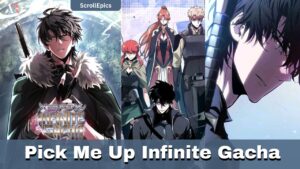
Beneath its flashy premise lies a surprisingly emotional and complex narrative about exhaustion, sacrifice, and the hollow cost of endless victory. It’s a story that begins like a standard “game-world survival” tale but gradually unravels into a haunting reflection on what it means to fight without end—and whether success still matters when it comes at the cost of one’s humanity.
For some, it’s one of the most emotionally powerful web novels in its genre—relentlessly depressing but deeply resonant. For others, its pacing issues and tonal shifts from tactical action to sorrowful introspection make it a difficult journey. Yet few would deny that Pick Me Up, Infinite Gacha leaves a lasting impression.
Where to Read Pick Me Up, Infinite Gacha Online
You can read Pick Me Up, Infinite Gacha through official and reputable sources that provide quality translations and support the author:
-
Tapas – Offers the licensed English translation with consistent updates and mobile-friendly formatting. Readers often note that the translation preserves both the emotional tone and game-like tension of the original Korean version.
-
Tappytoon (possible) – Some regions provide partial access through Tappytoon depending on licensing status.
These platforms ensure an authentic reading experience with faithful translations—keeping the story’s intensity, worldbuilding, and characters intact.
What Pick Me Up, Infinite Gacha Is Really About
At its heart, Pick Me Up, Infinite Gacha isn’t just about conquering a tower—it’s about the emotional burden of endless struggle.
The story follows Loki, a player trapped in a deadly game-like world known as the Tower. Alongside a team of heroes—each with unique origins and tragic pasts—he must climb through layers of despair, facing monstrous foes, ethical dilemmas, and the crushing repetition of combat.
But the true emotional core lies in its human cost. Every climb demands sacrifice. Every victory comes with loss. The tower becomes a mirror of obsession—where strength grows, but meaning fades.
Then there’s Aaron, one of the novel’s most impactful side characters. His arc embodies the spirit of persistence and futility intertwined. Readers describe his storyline as “something else”—beautiful, heartbreaking, and full of restrained pain. His journey, alongside allies like the daring Anythng (whose flying sequences near the end are unforgettable), cements the novel’s place as a tragedy wrapped in fantasy.
Still, Pick Me Up, Infinite Gacha isn’t just sadness for sadness’s sake. It explores what it means to keep going when the purpose is lost—to fight not for glory, but for the people who believed in you.
Battles That Carry Emotional Weight
One of the strongest elements of Pick Me Up, Infinite Gacha lies in its battle structure and tension.
Unlike many power-fantasy novels where the protagonist simply outmuscles every enemy, this story’s early arcs thrive on teamwork, tactical coordination, and the constant pressure of loss.
Readers frequently point out how Loki isn’t portrayed as a lone hero, but as a commander who depends on—and sometimes fails—his comrades. Each floor of the Tower pushes the team to their limits, and every victory feels like a miracle earned through strategy, sacrifice, and sheer will.
But this intensity comes with a cost.
As Loki becomes stronger, that hard-earned teamwork begins to fade. By the time the story passes the mid-stages (around Floor 50 onward), he starts fighting alone more often, not because he wants to—but because no one can keep up anymore.
That’s where the tragedy begins.
What started as a story about leadership and camaraderie slowly turns into one about isolation and burden. The further Loki climbs, the more his allies are lost—to death, fatigue, or despair—and what remains is a protagonist powerful enough to win, but too hollow to feel the victory.
“By chapter 200, it stops being a fight for survival and becomes a fight against loneliness,” one reviewer said—capturing what many readers feel by the final arcs.
The battles remain visually striking, but they evolve from displays of power into symbols of emotional exhaustion. Strength no longer feels like triumph—it feels like punishment.
Themes: Depression, Purpose, and the Cost of Persistence
If Pick Me Up, Infinite Gacha were only about the thrill of battle, it wouldn’t have made such a lasting mark. What makes it unforgettable is how deeply it dives into emotional burnout and existential despair.
Readers often describe it as “depressing yet addicting”. The story’s emotional rhythm swings between fleeting hope and crushing hopelessness, exploring how perseverance can become its own form of torment.
Characters like Aaron embody this perfectly. His determination, planning, and calculated approach to every obstacle show the beauty of human effort—but also the futility of it when faced with endless cycles. His arc is one of the most discussed in reviews, especially for the way it ends—not as a grand victory, but as a quietly devastating reflection on purpose.
The story asks unsettling questions:
-
Is there meaning in endless struggle?
-
When everything resets, what does “winning” even mean?
-
Can someone who’s lost everything still keep moving forward—without breaking?
These aren’t rhetorical—they’re the foundation of the entire novel.
The tone may be grim, but it’s also intellectually and emotionally rich. It portrays the human spirit not as an unbreakable flame, but as a flickering light that still refuses to die, no matter how many times it’s dimmed.
The Emotional Core: The Team That Made It Human
While Loki’s strength defines the action, his team defines the heart.
Characters like Anythng—whose courage and aerial combat moments bring both awe and heartbreak—remind readers that victory means nothing without people to share it with.
Even the side stories, which some readers found slow or redundant, serve a deeper function: they humanize the world. Through quieter moments of grief, laughter, and farewell, the novel gives emotional depth to those who would otherwise be forgotten in a sea of nameless heroes.
For some readers, these chapters were the soul of the story—raw, emotional, and deeply human. For others, they broke pacing and tone. Yet, even critics agree that these segments capture what Infinite Gacha does best: showing how connection and memory are what make survival bearable.
A World Built on Despair and Design
The world of Pick Me Up, Infinite Gacha is more than a backdrop—it’s a meticulously layered stage designed to test not just power, but endurance and morality.
From the earliest floors of the Tower, readers notice how each environment reflects the emotional state of the characters: cold, mechanical levels that mirror burnout; dreamlike illusions that question the meaning of identity; and battlefields that repeat endlessly, eroding the sense of time itself.
The Tower isn’t just a setting—it’s a metaphor.
Every climb up represents progress, but also a descent into hopelessness.
As one reviewer noted, “It feels like an infinite loop of effort and despair, where the real fight isn’t against monsters—it’s against giving up.”
That’s what makes Infinite Gacha stand out in the crowded tower-fantasy genre. While other novels rely on external spectacle, this one uses its world as an emotional ecosystem—a place that evolves as the characters fall apart.
And yet, amid the dread, there’s artistry. The worldbuilding feels deliberate—every arc has purpose, every floor introduces a new moral or psychological layer. It’s not always smooth, but it’s undeniably ambitious.
The Problem of Pacing
Still, not everything works perfectly.
Even fans who adore the story admit that Pick Me Up, Infinite Gacha stumbles in its mid-to-late pacing.
The first half is praised for its balance: clear goals, strong tension, and teamwork-driven action. But after around the 50th floor, many feel the story loses its rhythm.
Tactical battles fade into quicker, more straightforward victories as Loki’s power snowballs. The shift from group strategy to solo domination leaves emotional gaps that some readers found jarring.
Others argue that this drop in pacing is intentional—that it mirrors Loki’s isolation, his separation from the very people who gave meaning to his climb. What feels like rushed writing might, in another light, be a narrative choice: the story itself becoming fragmented as its protagonist breaks.
Even so, the result divides readers. Some find the later chapters powerful for their emotional realism; others see them as hollow compared to the brilliant early arcs.
Strengths and Weaknesses of Pick Me Up, Infinite Gacha
Where It Shines:
-
Emotional Realism: The novel doesn’t shy away from despair. Its exploration of grief, perseverance, and fatigue feels painfully authentic.
-
Team Dynamics (Early Arcs): Before the power curve tips, the interplay between teammates—especially Loki, Aaron, and Anythng—adds tension, humor, and humanity.
-
Philosophical Weight: It transforms what could’ve been a simple power fantasy into a meditation on meaning, loss, and self-destruction.
Where It Falters:
-
Uneven Pacing: The mid- to late-game arcs compress too much development into too little space, undermining the weight of earlier themes.
-
Side Story Fatigue: While some side stories enrich characters, others feel unnecessary or repetitive, especially those focusing on Niflheim’s higher ranks.
-
Diminished Stakes: Once Loki becomes too strong, suspense gives way to inevitability. Victories start feeling mechanical rather than earned.
Still, despite these issues, the story retains an emotional grip. Even its missteps seem to reflect its underlying message: that no climb—literal or emotional—is ever perfect. The unevenness mirrors the chaos of the struggle itself, and that raw imperfection gives the novel its soul.
Character Guide and Analysis
1. Islat Han (a.k.a. Han Seojin)
Role: Protagonist of the novel.
Aliases: Han Seojin (his Earth identity), among others.
Profile & traits: He begins as a top-ranker gamer “LOKI” in the game world of Pick Me Up!, but due to a bug ends up physically summoned as a low-level 1-star hero named Islat Han.
Physically: black hair, brown eyes (with special states like blue in a “challenging look” or red in Berserker mode).
Personality: Calm, rational, determined; experienced hardship (grew up without parents), used to unfairness, doesn’t rely on typical power fantasy tropes.
Significance: His journey underpins the novel’s major themes: enduring struggle, redefining strength, burden of leadership. Many supporting characters and events revolve around his decisions and survival.
2. Aaron Delkirt
Role: One of the key supporting characters whose arc receives significant attention in reviews.Profile & traits: Aaron is part of Loki’s team (or lobby) and is often noted for his tactical mindset, loyalty, and emotional resonance. According to reader feedback, his story is especially compelling: “What I imagined would happen … Aaron comes back super strong and everything but the tower climb is already over.”
Significance: Aaron embodies the cost of sacrifice and the idea that even when power is attained, it may no longer hold meaning. His arc is cited by many readers as one of the emotional high points of the novel.
3. Anythng
Role: Another major supporting character, frequently praised by readers for her unique role and impact.
Profile & traits: Known for her flying skills and dramatic scenes near the end of the novel. One review: “I especially loved Anythng and her epic flying skills near the end. She was so cool.” Represents hope, freedom, and the emotional counterpoint to the heavy weight of the tower’s progression.
Significance: Anythng’s arc highlights the emotional cost of survival and how strength isn’t always measured purely by power—it’s also about what you give up and who you save. Her presence reminds the reader of what the climb should mean: connection, sacrifice, and legacy.
4. Jenna Shirai (sometimes “Jenna Cirai”)
Role: Supporting hero from the “Townia” lobby (one of the groups in the story).
Profile & traits: Early on, she is introduced as part of the initial team—Jenna’s relationship with Islat Han (Loki) is significant: she is one of his subordinates. While strong, her role fades somewhat in later arcs (some reviewers note her being sidelined).
Significance: Jenna represents the “team” aspect of the novel’s early phase: cooperation, growth together, and support roles. Her later sidelining underscores one of the novel’s criticisms: the shift from team dynamics to solo dominance.
5. Belquist
Role: Supporting character from the “Niflheim” lobby side of the story.
Profile & traits: According to reader commentary, Belquist (and others like Jenna) become less central in the later arcs: “Side characters from Townia, like Belquist and Jenna, were pretty much sidelined until the very end of the story.” His arc is one of the many side stories that some readers found enriching, others found redundant.
Significance: Belquist illustrates the novel’s shift in focus and thematic centre. His sidelining is not just a narrative choice but symbolic of the core protagonist’s isolation He also helps illustrate the expansive cast and worldbuilding—adding layers beyond just the main trio.
6. Sirres Adienthem
Role: A hero from Niflheim lobby, representing the “enemy lobby turned ally/rival” nuance.
Profile & traits: His inclusion reflects the novel’s larger cast of heroes from different lobbies and origins—Townia vs Niflheim. He works as part of the bigger team dynamic, representing that the journey isn’t just local to one group.
Significance: Sirres adds complexity to the interpersonal dynamics: rivalry, loyalty, strategy, and ideological contrast. His presence complements the theme of “many human stories under one tower climb”.
7. Eolka Rivel Strashur
Role: Another supporting character drawn from the Townia roster, included in many of the major event arcs.
Profile & traits: While less spotlighted than the main trio, she assists in team events, missions and contributes to the “team vs tower” theme. Helps show the broader community of heroes climbing alongside the protagonist—adding depth to the ensemble.
Significance: Her presence reminds us that the main hero’s story is built on the backs of many others. Also highlights the novel’s theme of sacrifice: many characters besides the MC pay the price.
Is Pick Me Up, Infinite Gacha Worth Reading?
Absolutely—if you know what you’re signing up for.
This isn’t your typical “OP protagonist conquers everything” story. It’s a journey that starts with intensity and purpose, then gradually transforms into something heavier, more introspective, and emotionally draining.
Readers who come for the strategy-driven early arcs—filled with teamwork, planning, and sharp tactical sequences—will find the first half thrilling. But those who stay for the emotional devastation and philosophical undertones will discover the story’s deeper brilliance.
Its greatest strengths lie in how it examines despair, endurance, and the meaning of victory. Through characters like Islat Han (Loki), Aaron, and Anythng, it portrays the evolution from camaraderie to solitude, from leadership to isolation, and from survival to emotional ruin.
But it isn’t flawless.
The pacing falters after the midpoint, and the power scaling undermines some of the tension that made the early arcs gripping. Side stories about the Niflheim heroes divide readers—some find them heartfelt expansions, others see them as unnecessary detours.
Even so, what remains undeniable is that Pick Me Up, Infinite Gacha captures something rare: the exhaustion of endless struggle and the bittersweet realization that not every fight leads to glory. It’s bleak, powerful, and profoundly human.
For readers who loved Omniscient Reader’s Viewpoint or SSS-Class Suicide Hunter but wanted something even more emotionally brutal—this novel stands proudly beside them.
What Pick Me Up, Infinite Gacha Does Well
-
Emotional Depth: The novel isn’t afraid to be raw and painful. It makes you care about its characters, then forces you to confront their losses.
-
Early Team Dynamics: The initial balance between Loki and his party is one of the strongest in the genre, emphasizing teamwork over raw power.
-
Psychological Weight: The story dares to explore depression, burnout, and identity in a genre usually focused on victories.
-
Worldbuilding: The tower’s complexity and its morally ambiguous factions (like Niflheim and Townia) add genuine depth to the setting.
Where It Struggles
-
Rushed Late Arcs: After floor 50, the pacing accelerates unnaturally, making the climax feel compressed.
-
Solo Power Fatigue: Once Loki becomes too dominant, the tension and teamwork vanish, reducing emotional stakes.
-
Side Story Overload: Some chapters—especially those focusing on secondary heroes—feel unnecessary and slow the narrative momentum.
Overall Verdict
⭐ Rating: 8.5 / 10
Pick Me Up, Infinite Gacha is not perfect, but it’s unforgettable. It delivers one of the most emotionally charged experiences in the tower-climbing genre—filled with sorrow, resolve, and quiet triumphs that linger long after the last chapter.
It’s a story about strength, but also about breaking—a meditation on how far someone can go before they lose themselves, and whether the act of enduring alone can still be called victory.
For readers who crave philosophical weight beneath the spectacle, this novel delivers that rare balance of power and pain that defines great Korean web fiction.
Pick Me Up, Infinite Gacha — FAQ
What is Pick Me Up, Infinite Gacha about?
It follows Han Seojin (Islat Han / Loki), a top-ranker gamer who’s transported into the gacha world of his own game. Starting as a low-tier 1-star hero, he must rebuild his power and team to climb the Tower while facing psychological exhaustion, endless battle, and moral decay.
Where can I read the Pick Me Up Infinite Gacha Novel?
Official English translations are available on Tapas, Amazon Kindle, and (regionally) Tappytoon. These provide legal and consistent updates.
Is the Pick Me Up Infinite Gacha Novel complete?
The Korean original continues serialization, while English versions are still updating steadily.
Does Pick Me Up Infinite Gacha Novel have romance?
Romance exists but is not central. Emotional bonds—especially friendship, loyalty, and grief—define the story far more than romantic subplots.
Is it dark or violent?
Yes. Expect psychological trauma, character deaths, and bleak emotional tones. It’s not gratuitous, but it’s emotionally heavy.
Who are the main characters of Pick Me Up Infinite Gacha Novel?
-
Islat Han (Loki / Han Seojin) — The protagonist; a master strategist turned tragic hero.
-
Aaron Delkirt — The disciplined, selfless right-hand man.
-
Anythng — The courageous flier who symbolizes hope.
-
Jenna Shirai, Belquist, Sirres, and Eolka Rivel — Companions whose fates illustrate the loneliness of progress.
Why is it so emotionally intense?
Because the novel isn’t about power—it’s about what power costs. Each victory strips something away, leaving behind a story that feels both epic and heartbreakingly intimate.
![I Am Not a Regressor Novel & Manhwa – Wiki, Review, Characters Latest [2025]](https://www.scrollepics.com/wp-content/uploads/2025/12/I-Am-Not-a-Regressor-1024x576.jpg)